Monday, May 2, 2011

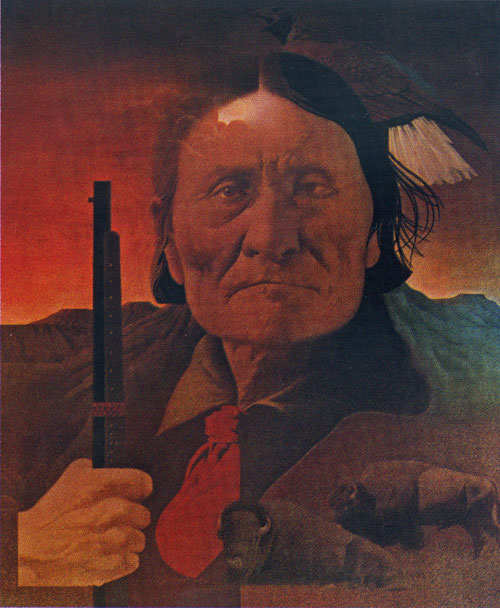
Illustrator Mark English


Illustrator Mark English (b. 1933) holds the distinction of being the most awarded illustrator in the history of the Society of Illustrators in New York. Born in Texas, he escaped working in cotton fields to become a sign painter. He then studied at the University of Texas and went on to graduate in 1960 from The Art Center College in Los Angeles.


Throughout the 60s, 70s and 80s, Mark English's work appeared in publications like McCalls, Time and Redbook. He produced numerous magazine covers as well as the iconic illustration above, for the Who album, Tommy.


English's illustrations are an instantly recognizable mixture of paint and pastel, hard-edged geometry and rich modeling, and dark backgrounds with ghostly translucent highlights.


In 1983, Mark English was inducted into the Society of Illustrators Hall of Fame in New York.


For a number of years, Mark English was associated with the O'Grady Gallery, and in 1995 his career segued into gallery exhibitions all around the world.


Below is a more recent painting ...

markenglishonline.com

Today Mark English lives in Kansas City, Missouri. More of his recent paintings can be found at his website, here.
.

My Delightful Surprise


This past weekend I had a surprise gift from my blogging friend Gina Garner of Art and Alfalfa. It seems she had an unannounced contest that I won just for having left a comment that rang true for her. And now I am the proud owner of one of her charming and distinctive tiles!


Be sure to check Gina's blog and her upcoming class.
Thanks, Gina — I love the tile!
.

Friday, April 29, 2011

J. P. Morgan Meets the Duveens


I've been rereading an entertaining and absorbing book from 1952, Duveen, by S. N. Behrman. It's the biography of Joseph Duveen, later Lord Duveen, the son of an antiques trader, and one of the greatest art dealers of all time.


Joseph Duveen learned the antiques trade from his father, Joseph Joel Duveen, and from his uncle, Henry Duveen. Eventually he went on to specialize — with huge success — in selling Old Masters. In partnership with Bernard Berenson, who authenticated paintings, Duveen provided a steady stream of masterpieces to eager industrialists like Kress, Mellon, Hearst and Frick. What makes the book so entertaining is that Lord Duveen understood the personalities of American millionaires and catered to them, while also playing incredible mind games with them.

One of my favorite moments in art history is recounted early in the book, when J. P. Morgan (as cagey as they come) decided to test Joseph Joel Duveen. He had heard that the elder Duveen was an expert in Chinese ceramics, so he invited the Duveens for a visit. When Joseph Joel, Uncle Henry and the young Joseph Duveen arrived, J. P. Morgan showed them five Chinese ceramic beakers. He explained that three were priceless, and that two were fakes. "Tell me which ones are the fakes."


The elder Duveen studied the five ceramics, then raised his cane and with great force, smashed two of them! He explained that if he were mistaken, he'd of course reimburse Morgan for the loss. Duveen had been correct, and the astonished J. P. Morgan was both relieved and impressed.

And that was just part of the training for Joseph Duveen, later Lord Duveen.

Morgan went on to use the Duveens in many dealings.
.

Wednesday, April 27, 2011

Tobacco Ephemera 5


While silks are not technically ephemera, they were among the many premiums distributed by early 20th century tobacco companies. I don't actively collect tobacco silks, but they occasionally show up in trade card collections. This silk and the two that follow were distributed by Nebo and Zira cigarettes, early brands of the American Tobacco Company. They date to circa 1910. King Ferdinand was one of a set of 10 called Rulers of the Balkans and Italy.


Queen Ester and Queen Louisa were part of a set of 15 call Famous Queens.

click to enlarge

Tobacco silks came in a variety of sizes and were popular with collectors, who often sewed them into quilts. This quilt is from Fabrics.net, and similar tobacco quilts can be seen at that site, here. Also at Fabrics.net are smaller quilts, perhaps table covers or wall decorations, that were made from the colorful yellow ribbons that were used to tie up bundles of cigars.

My thanks to Fabrics.net.
.

Monday, April 25, 2011

Tobacco Ephemera 4


The image above must have been shockingly racey and sexy when it was printed in the 1880s. No lady would have smoked in public then — or bared so much shoulder (gasp!). At 6", this die cut is larger than most trade cards.
.

Saturday, April 23, 2011

Tobacco Ephemera 3

click to enlarge any of these three
Horseshoe Cross Bar was a cut plug tobacco. (It appears that in the 1800s, just as today, cut plug was associated with sports!)

Much of my antique advertising collection is in the form of trade cards, and if you haven't had a chance to view my page on trade cards (in the sidebar), you can access it here.

Horseshoe Cross Bar issued trade cards that looked like the image above, though this example and the two images below are actually from packaging. When the Victorians were pasting trade cards into their albums, they often also included packaging scraps. And aren't we glad they did!


I want to note here that these colors have not in any way been enhanced. The Victorians did not used the 4-color printing process that we use today. So in these lithographed pieces, if a brilliant orange-red was desired, a brilliant orange-red ink was used.
.

Thursday, April 21, 2011

Tobacco Ephemera 2


Ephemera, as I've mentioned before, is paper memorabilia that was never intended to be saved. This is a wonderful example of ephemera — it's a paper packet that held three cheroots. Someone long, long ago liked the design enough that they set it aside, and if not for them, we wouldn't be looking at this great example of Victorian graphic design.

click to enlarge

Just what is a "cheroot?" It's a small cigar that's clipped at both ends. Because the ends don't taper, the cheroot is easier and faster to roll and therefore less expensive than finer cigars.


I wish I could reach out and share this in person! This packaging is printed with a gold ink that is quite reflective now; it must have absolutely glistened in 1886.
.