Monday, May 23, 2011

I'm Back From a Trip to New York City

Sea glass from Martha's Vineyard and Cape Cod

I'm back from a week in New York, where I spent some of my time researching a painting project. I stayed at the home of a family friend who is more of a collector than even this blogger! With her permission, I'm sharing a taste of her interests and fascinating apartment.

A small portion of a collection of woven straw baskets from around the world

One of many family hooked rugs

A grouping of dolls mounted on an antique post card rack

Carved animals
I'll share more of my New York trip later in the week. I still have to unpack!
.

Thursday, May 19, 2011

Dating a Reward of Merit


Rewards of merit, as I've mentioned before, are those delightful cards that children of the 19th century received for good scholarship. To look at their designs and verses, one can guage how much more serious (and compliant) students of 150 years ago were.


How lovely, how charming, the sight,
When children their teachers obey;
The angels look down with delight,
This beautiful scene to survey.

Judging by the design, the make of the paper — which has a clay finish — and the hand-tinting, I would date this to well before the Civil War. Indeed, it may have come from a cache some teacher retained for twenty years. But turn the reward over, and look at the back:

On the back, someone has pasted a portrait of General George B. McClellan, popularly known as the "Little Napoleon." It was probably clipped from a newspaper, like Harper's Weekly.


General George Brinton McClellan entered the Civil War with a sterling reputation earned during the Mexican War. And when he was appointed commander of the Army of the Potomac, McClellan was recognized as a good organizer and administrator. But he proved unready to command in battle, more interested in drilling troops than engaging in combat. After the Battle of Antietam, which Robert E. Lee lost, McClellan refused to pursue the retreating southern army, which might well have ended the Civil War years earlier. As the Army of the Potomac bogged down through his own poor leadership, McClellan blamed Lincoln and Lincoln's cabinet, then ultimately came to despise Lincoln. In 1864, McClellan resigned his commission in the Army and ran against Abraham Lincoln for President.

So while the reward of merit is of an earlier design, it probably dates between 1861, when McClellan organized the Army of the Potomac, and 1864, when McClellan was the Democratic candidate for President. My guess is 1864.

George B. McClellan served as the 24th governor of New Jersey (1878-1881) and died in 1885.
.

Saturday, May 14, 2011

Coquille Paper

Mark D. Ruffner

Coquille paper, also known as coquille board, is a thick white paper with a pebbled texture. Through the wonders of PhotoShop, I've scanned some coquille paper so that we can see its texture.


The benefit of drawing on coquille paper, aside from the fact that it provides an interesting texture, is that the pencil lead against the textured paper essentially creates its own halftone.

Mark D. Ruffner
The above illustration, for a municipal securities company, was printed without a halftone screen, and yet it appears as a halftone.


Mark D. Ruffner
Here's a scan of original art for the same company. If you click on the drawing to enlarge it, you can see the paper's texture. As this scan demonstrates, even though the paper forms its own halftone, the drawing could be even richer when screened. My concern would be whether the camera would see a screen of a screen and then form a moire pattern. I don't know because...  I've never tried it!
Mark D. Ruffner
This is my favorite illustration on coquille paper. I created it for PPG Industries, which made a product that eliminated hydrogen sulfide (which has a smell we associate with rotten eggs). Hydrogen sulfide, aside from having a noxious smell, is toxic and can form sulfuric acid, which in turn will rapidly corrode concrete and metal piping. The headline for the ad said, "You don't get rid of hydrogen sulfide by covering it up."
.

Tuesday, May 10, 2011

What's in Your Pocket?


Some years ago, a friend gave me a photograph of all Mahatma Gandhi's worldly possessions at the time of his death, in 1948. The photo was remarkable in that there were less than two dozen items total, including a 1910 Zenith pocket watch and his spectacles.

The Moderate Voice

This past March, five of those items were auctioned off in New York, causing much concern in India that ownership might pass to another country. There was an intense bidding war which was finally won by the Indian billionaire, Vijay Mallya, chairman of United Breweries Group and Kingfisher Airlines. Gandhi's relics would stay in India after all. The five items sold for $1.8-million.

The image of those items got me to thinking of a couple of similar photographs.

Thomas Jefferson Memorial Foundation
Above are the contents of Thomas Jefferson's pockets, found after his death. They include (clockwise from upper right): a key ring and trunk key, a gold toothpick, a goose quill toothpick, a pocket knife, an ivory rule, a watch fob, steel pocket scissors, and a red leather pocketbook.

National Park Service
Above are the contents of Abraham Lincoln's pockets the night he attended Ford's Theater. They include (clockwise from the right): newspaper clippings, a pocket knife, a monogrammed button, eyeglasses and eyeglass case, a watch fob, an eyeglass buffer, a monogrammed handkerchief, a wallet with a Confederate bill, and a second pair of eyeglasses and case.


Library of Congress

Library of Congress

One need not be famous for such collections to be of interest. My friend John Atkinson sent me images of a few of the many items that were found in the wallet of his grandfather, Dr. Harry H. Atkinson (1880-1932).


Dr. Atkinson was an avid hunter and outdoors man.


One of the more interesting articles found in Dr. Atkinson's wallet was a Civil War letter from his grandmother to his father and uncle. The uncle was killed weeks later. Dr. Atkinson must have carried this for decades.

Would the contents of your pockets or wallet reveal your character, or a provide a window into your personality?
.

Friday, May 6, 2011

The Vinoy Hotel

Historic Old Northeast Neighborhood Association

The premier hotel in St. Petersburg, Florida is the Vinoy. It sits on St. Petersburg's Tampa Bay waterfront, adjoining a park with royal palms, and oak and banyan trees.

Photo by Joe Rosh, 2007
The hotel was constructed in 329 days — all within the year 1925 — in a race to open on New Year's Eve, 1925!

Historic Old Northeast Neighborhood Association
Norma Dew Sleeper, a St. Petersburg resident who attended the Grand Opening, said of the evening, "It was so glittering and exciting. There were search lights casting rays in the sky just like they did at Hollywood parties, and everyone felt like a celebrity."*

The hotel attracted famous guests for decades, but went into a slow decline. By the 1970s, an overnight stay cost only about $20, and in 1974 the hotel closed.

The Vinoy then suffered from eighteen years of neglect. Teens partied in the empty ballroom, derelicts slept where they could, windows were broken, and finally the hotel was surrounded by a chain link fence and written off for demolition. I remember it in that state, and it was an eyesore.

In 1978, though, the Vinoy was placed on the National Register of Historic Places, and a succession of owners and investors spent $93-million to bring it back to its old glory. In 1992, the Vinoy reopened, as beautiful as ever.

Historic Old Northeast Neighborhood Association
Above, the Vinoy in ruins and below, those same views as seen today.

Photo, Mark D. Ruffner

The entrance to the Vinoy is as Baroque as they come. Unfortunately, there's a porte cochere directly in front of it, so it can be viewed only at close range. Still, it's spectacular.

Photo, Mark D. Ruffner

Photos, Mark D. Ruffner
Original tilework survived, and they shine with a patina that makes them look like gold.


The photographs in this posting that are credited to the Historic Old Northeast Neighborhood Association, and the quotation from Norma Dew Sleeper, come from the award-winning book above, Views from the Vinoy. It's indeed a well-designed and interesting souvenir of St. Petersburg.

And if you're ever in St. Petersburg, be sure to visit the Vinoy.
.

Monday, May 2, 2011

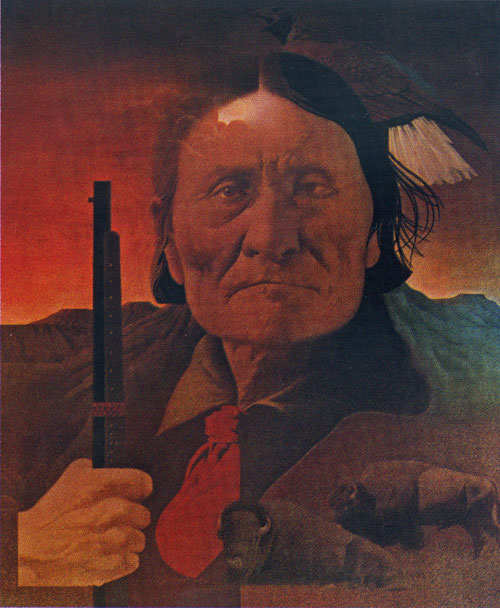
Illustrator Mark English


Illustrator Mark English (b. 1933) holds the distinction of being the most awarded illustrator in the history of the Society of Illustrators in New York. Born in Texas, he escaped working in cotton fields to become a sign painter. He then studied at the University of Texas and went on to graduate in 1960 from The Art Center College in Los Angeles.


Throughout the 60s, 70s and 80s, Mark English's work appeared in publications like McCalls, Time and Redbook. He produced numerous magazine covers as well as the iconic illustration above, for the Who album, Tommy.


English's illustrations are an instantly recognizable mixture of paint and pastel, hard-edged geometry and rich modeling, and dark backgrounds with ghostly translucent highlights.


In 1983, Mark English was inducted into the Society of Illustrators Hall of Fame in New York.


For a number of years, Mark English was associated with the O'Grady Gallery, and in 1995 his career segued into gallery exhibitions all around the world.


Below is a more recent painting ...

markenglishonline.com

Today Mark English lives in Kansas City, Missouri. More of his recent paintings can be found at his website, here.
.

My Delightful Surprise


This past weekend I had a surprise gift from my blogging friend Gina Garner of Art and Alfalfa. It seems she had an unannounced contest that I won just for having left a comment that rang true for her. And now I am the proud owner of one of her charming and distinctive tiles!


Be sure to check Gina's blog and her upcoming class.
Thanks, Gina — I love the tile!
.