Monday, June 13, 2011

Mandala Meditations 2


This  past weekend I gave my second talk in a year on mandalas. I talked about creating mandalas as a form of meditation in an earlier posting, which can be found here.

Saturday's talk was part of a day-long seminar on Hildegard of Bingen (1098-1179), who was a Christian mystic, Benedictine abbess, and a writer of texts on philosophy, botany and medicine. She was also a composer, a founder of two monasteries and an advisor to popes. Hildegard had an encyclopedic mind, and as a 12th-century woman, held a unique status in the Catholic church.


Hildegard of Bingen also created mandala illuminations as a way of interpreting and explaining her visions. I was therefore asked to talk about mandalas, which I consider tools for centering and balancing, or as graphic meditations.

Mark D. Ruffner

At an initial stage, I approach mandalas loosely — without compasses, protractors or rulers — because I want to stay in a flow. I often use the backs of inexpensive paper plates since they're embossed with a circle, and therefore make great templates. I work relatively quickly with magic markers, and I might create six such mandalas in about an hour. If I don't like the direction of the mandala, or if I intuitively feel that it's finished, I simply pick up another paper plate.

I always start the mandala process in a meditative state, and as is often true with the creative process, I find myself going into another level of consciousness. The primary value of creating a mandala (for me) is that the process allows one to tap into a deeper self; that one can end up with an interesting or beautiful finished image is an extra reward. I liken mandala-making to the adage that the journey can be more important than the destination.

Often a mandala reveals itself to me in the process, and I discover a theme that can be powerful or seemingly mundane, but in any case a reflection of some level of my consciousness. When I completed the above mandala, I interpreted it as an immense space station, perhaps several miles wide. I enjoyed the image, it fired my imagination, and so I decided to refine it by redrawing it and then coloring it by computer.

Mark D. Ruffner

Now my mandala is pure fantasy, but it's still a tool of balancing, centering and symbolism. The center (which for me is always the most important part of the mandala) becomes an energy source. The number three is repeated many times, and for those interested in numerology, the blue pyramids encircled by orange (their complementary color) add up to 12 sides. As I recognize the symbolism that I've created subconsciously, I want to continue to reinterpret at a conscious level.

Mark D. Ruffner

So I begin, on the computer, to create the next level of mandala. What you see above is just one layer of a mandala that will have several layers, each a mandala unto itself. But I offer this early stage as an interesting viewing exercise. Stare at it over time and it will vibrate, become 3-dimensional and draw you in.
.

Thursday, June 9, 2011

Original Mid-Century Modern


My friend José Perez lives in a Mid-Century home so classic in its design that advertising agencies occasionally request to stage photoshoots there. José has collected modern art and furniture since high school, so when the 1957 ranch house came on the market, it was a natural fit for him and his collections.


Barcelona chairs greet one at the entrance, and in the distance one can see a Warhol print of Jackie Onassis. The original floor was concrete, covered with a white shag carpet (edgy for 1957), so José laid tile throughout the house.


One of my favorite features is the living room's built-in sand garden. It was doubtlessly designed as a planter, but the sand garden fits the living room's black and white minimalism perfectly, and contributes to the room's calming atmosphere.


A step down from the living room is the lanai, which runs the entire width of the house. It serves to extend the living room, and is a natural center for entertaining. The white wire chairs are by Harry Bertoia and the kidney-shaped mosaic bar is an original built-in. The lanai juts out at an interesting angle to perfectly frame a peaceful lake.


Halfway between the dining area and the kitchen, an image of Jackie Onassis peers over an Eames chair. The aquarium is original to the house. Through the years, José has collected numerous classic 50's clocks, but he's constantly in the process of editing. The one above is a keeper.


St. Petersburg artist Andrea Pawlisz painted the console's top.


A banquette original to the house frames the kitchen. José had it reupholstered a bright orange.


The kitchen has been completely remodeled with IKEA products — only the hood is original.


The TV room got a major redo several years ago, when José had built-ins constructed to better display his large collection of modern American pottery — all of it white. Most of this collection is McCoy. Beautiful louvered doors of gleaming wood hang throughout the house, and are original to it. José has researched property cards and building permits, but the names of the architect and builder remain a mystery.


Jonathan Adler sculptures complement the McCoy pottery.


Tan, ecru and rich wood tones make the bedroom mellow and inviting. The platform bed was custom-made to José's design.


The master bath is all original, including the massive built-in sink. Notice how it's up off the ground for circulation. José says that this is true of all the home's built-in furniture. He's attracted to Mid-Century architecture because it's practical and comfortable, with indoor/outdoor fusion appropriate to Florida style.


A smaller bathroom is decorated with Florida and St. Petersburg art and artifacts. Several years ago, José and I collaborated on the Greater Pinellas Point neighborhood logo, above right. It's always fun to collaborate with someone who has such a discerning eye!
.

Sunday, June 5, 2011

Seymour Chwast, the Left-Handed Designer


Seymour Chwast (b. 1931) has been a published designer and illustrator for 64 years! He grew up in New York and attended WPA-sponsored art classes as a child. He then attended Cooper Union in 1948 with another great designer, Milton Glaser. They formed a bond which in 1954 resulted in the founding of Push Pin studio.

Push Pin was at the leading edge of a design revolution that signaled the end of the age of Norman Rockwell. The studio incorporated many styles from the past — Victoriana, Art Nouveau, Art Deco — and made them refreshing and contemporary. Many designers and illustrators, including Paul Davis, were associated with Push Pin through the decades, and the collaborative approach of the studio kept illustrations and designs exciting and ground-breaking. Chwast also personally thrived through collaboration.

When Milton Glaser left Push Pin in 1975, Chwast continued as its director, and Push Pin Graphic was published as a magazine. Next came Push Pin Press, which packaged books, and in the 1980s, The Pushpin Group.

In 1984, Seymour Chwast was inducted into the Art Director's Hall of Fame.

Seymour Chwast has designed record and magazine covers, advertisements, posters, books, packaging, typefaces, all with humor and great imagination.

Illustrations for a Seymour Chwast retrospective

A 1965 2-inch Chwast illustration that I've saved in my files for 46 years!

Three Chwast posters

CBS Records

Chwast book cover

Chwast book, with Martin Stephen Muskof  |  MCGraw-Hill Books

A 1981 Chwast typeface, available from Linotype library


Wednesday, June 1, 2011

Lunch in Safety Harbor, Florida


Last week I had lunch with dear friends in Safety Harbor, Florida. Safety Harbor is a small town with quaint buildings; it's sleepy and charming. It's also quite an artists' community.


We had lunch at the Green Springs restaurant. Good food, a guitarist to serenade us, and the dining room had a remarkable mural of a lush jungle, by artist Kumpa Tawornprom.


After lunch, my friends were eager to show me "the tree." Below is the Baranoff Tree, reportedly the oldest Live Oak Tree in Pinellas County. It's estimated to be between 300 and 500 years old. The sign says that the tree, which takes up a whole block, is registered with the Live Oak Society of the Louisiana Garden Club Federation.


There was one more treat after lunch — a visit to the home of one of the local artists. The header of this posting shows part of the house. Here's more:


The house across the street, below, was not to be outdone. Those white tiles around the windows are actually pieces of mirror, and the neighbor's house glistens.


Limbs bordering the neighbor's yard. There was a third house in the immediate vicinity. It was painted bright purple, but looked very conservative next to the other two!
>

Friday, May 27, 2011

Antique Graffiti

Metropolitan Museum of Art

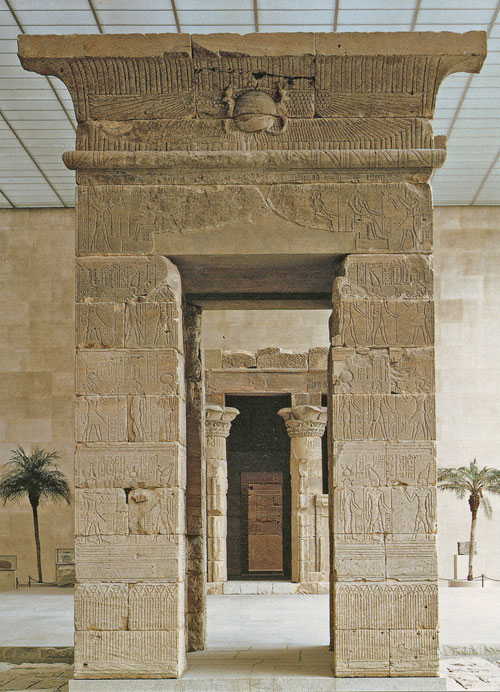
When I was in New York, I spent two full days at the Metropolitan Museum of Art. I won't say that I scratched the surface, but needless-to-say, I didn't see everything, either. One part of the museum that should be on every one's list is the Temple of Dendur. It dates to 15 B.C., was a gift to the United States from Egypt, and is beautifully displayed, actually staged, in the Sackler Wing.

One thing that's interesting about the Temple of Dendur is that it is covered with 18th and 19th century Western graffiti. It's inescapable.

Of course some of this graffiti is itself historic, going back to European expeditions to Egypt.

The word "graffiti" comes the Italian word "graffiato," meaning "scratched." So this is graffiti in its truest sense. At some level, graffiti has always been a reflection of the human need for imortality. Archeologists found the words "Lucius pinxit" (Lucius painted this) on a wall of Pompeii, and similar graffiti abounds from ancient times.

The relative newness, though, of this graffiti is disturbing to me. Seeing so much graffiti on the Temple of Dendur makes me wonder whether the Egyptians smiled to themselves and said, "Let's give them what they've already claimed so many times."

 As I said, I visitied the Metropolitan Museum of Art,
but I won't say that I scratched the surface.
.

Tuesday, May 24, 2011

New York City Building Details


While I was in New York, I really didn't travel a very wide path. Nonetheless, wherever I looked, I saw wonderful architectural details. And the more one looks at the city's carved portals, window frames and friezes, the more one realizes that New York of the 1800s and early 1900s must have had armies of stone carvers.

These two keystone cartouches (my own label for them)
were next door to each other.


These stones, which are indented like rows of dominoes,
are doubtlessly cast, but they complement lovely carved pieces.


Where will you find such detail today?


This detail is probably cast,
but I saw many companions to it that were carved.


This detail, from the same neighborhood,
brought the Treasury at Petra to mind.


Perhaps these figures were inspired by their cousins
at the Metropolitan Museum of Art.
.