Showing posts with label rewards of merit. Show all posts

Thursday, May 19, 2011

Dating a Reward of Merit


Rewards of merit, as I've mentioned before, are those delightful cards that children of the 19th century received for good scholarship. To look at their designs and verses, one can guage how much more serious (and compliant) students of 150 years ago were.


How lovely, how charming, the sight,
When children their teachers obey;
The angels look down with delight,
This beautiful scene to survey.

Judging by the design, the make of the paper — which has a clay finish — and the hand-tinting, I would date this to well before the Civil War. Indeed, it may have come from a cache some teacher retained for twenty years. But turn the reward over, and look at the back:

On the back, someone has pasted a portrait of General George B. McClellan, popularly known as the "Little Napoleon." It was probably clipped from a newspaper, like Harper's Weekly.


General George Brinton McClellan entered the Civil War with a sterling reputation earned during the Mexican War. And when he was appointed commander of the Army of the Potomac, McClellan was recognized as a good organizer and administrator. But he proved unready to command in battle, more interested in drilling troops than engaging in combat. After the Battle of Antietam, which Robert E. Lee lost, McClellan refused to pursue the retreating southern army, which might well have ended the Civil War years earlier. As the Army of the Potomac bogged down through his own poor leadership, McClellan blamed Lincoln and Lincoln's cabinet, then ultimately came to despise Lincoln. In 1864, McClellan resigned his commission in the Army and ran against Abraham Lincoln for President.

So while the reward of merit is of an earlier design, it probably dates between 1861, when McClellan organized the Army of the Potomac, and 1864, when McClellan was the Democratic candidate for President. My guess is 1864.

George B. McClellan served as the 24th governor of New Jersey (1878-1881) and died in 1885.
.

Monday, November 29, 2010

The Reward of the Great Eastern

I collect 19th century school rewards, which were known as Rewards of Merit. In the second half of the century, they were usually lithographed and looked like little trade cards, but in the early 1800s, they were engraved and looked like bank notes. In fact, sometimes these bond-like rewards could be saved up by students and redeemed for a larger prize, like a book or watercolor set.

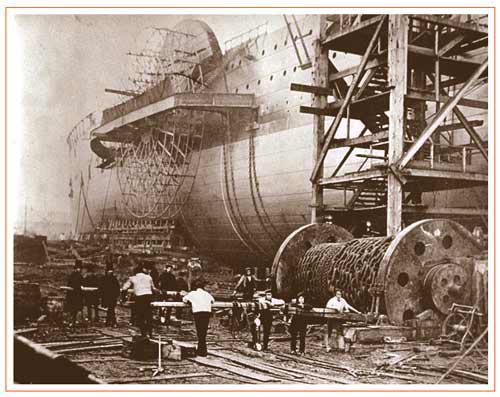
One of my rewards is this engraving of a metal-hulled ship with paddles, masts and a funnel. Though the masts are too few, I wonder if the artist intended the engraving to represent the Great Eastern.

In 1852, Isambard Kingdom Brunel designed a ship to transport emigrants to the United States. It was 692 feet long, which was six times larger than any ship of the time. It could hold 4,000 passengers, and was named the Great Eastern.

 The Great Eastern was launched January 31, 1858, after several false attempts.

The Great Eastern had six masts, two paddle wheels, one propeller and five engines. It was the first ship to use a double-skinned hull, and its launch was the source of much excitement. It had a long career, was used to lay a good portion of the transatlantic telegraph cable, and was finally broken apart in 1889.

What I enjoy about this reward — whether or not it represents the Great Eastern — is knowing that the child who received it was probably as excited as if it had been of a photograph of a rocket blasting off into space! And isn't it so much classier than this?