Wednesday, January 19, 2011

A Fun Resolution to a Bathroom Dilemma


My friends Sandy and Greg recently bought a rental house in need of much cleaning and restoration. Fortunately for them, the house was very solid and many of the problems were cosmetic. Also, the last and original owner had never made "improvements," which in my experience are often harder to undo than anything original to a house.

Notice the terrazzo floor, a great plus in older Florida houses.

The bathroom posed an interesting problem. The original 1948, built-in sink was in bad shape and needed to be replaced. It had been a little deeper than the design of current sinks, which meant that when the new sink was installed, at least a dozen tiles would need to be replaced. Have you ever tried to match 63-year-old tiles? It's virtually impossible, and the budget wouldn't allow for all new tiling.

My suggestion was to fill the space with a plasterboard that was painted the exact color of the tiles. Today, through the wonder of scanners and computers, paint stores can match virtually anything you hand them, so that wasn't a problem. They matched the small tile at the beginning of this post.


And here's a view of the finished project. It's not seamless, but it's a fun solution — and a bathroom conversation piece to boot!


Sunday, January 16, 2011

Inside the New Dali Museum


In my last posting, I showed this view of St. Petersburg's new Dali Museum. Now we'll go inside for an Opening Day tour!

One enters and leaves the Dali Museum through a colorful store that's a repository of all things surreal. Every imaginable book pertaining to surrealism is represented, as well as books on subject matter that interested Dali, such as the Golden Mean.

Next to the gift shop is this classic Rolls-Royce, covered in seaweed and snails. The driver wears antique diving gear and the passenger is a mermaid.

The windows are designed to appear as though it's always raining inside the car, and lighting and sound effects evoke a thunderstorm.

The ground floor has a café with a sitting area, as well as a counter with these cool stools.

After the geodesic glass, the focus of the museum's interior is a spiraling staircase, modeled after the DNA double helix. It was a shape that intrigued Salvador Dali.

The view is of the St. Petersburg bayfront, and Tampa Bay.


I thought this tangent structure was interesting.

Some of Salvador Dali's most famous works are actually surprisingly small. Beginning in 1948, though, Dali worked on a monumental scale, and these later pieces are referred to as "masterworks." I would have loved to have shown you peeks into the galleries, but museum rules forbid photographing those areas. Suffice to say, masterworks abound in the most comprehensive collection of Dali, and the largest collection of his work beyond Spain.


 1 Dali Blvd., on the St. Petersburg bayfront,
at the southern end of Bayshore Drive SE

Hours: 10-5:30 p.m., Monday, Tuesday, Wednesday, Friday and Saturday
10 a.m.-8 p.m., Thursday  •  Noon-5:30 p.m., Sunday


Thursday, January 13, 2011

The New Dali Museum Opens

This past Tuesday, at 11:11 a.m. (numerology that would have pleased Salvador Dali), I joined about a thousand other guests and spectators to celebrate the opening of St. Petersburg's new Dali Museum.

Lots of people got in the spirit of the day and came in Dali costumes, like Janice Embrey Brown (l.) and B. J. Ebersold (r.), both Dali Museum docents.

There was also a large and colorful contingent from the Krewe of the Knights of Sant' Yago.

I don't think anyone would argue that the most ardent Dali supporter that morning was a young man named Daniel.

The ceremonies began with a parade from the old museum to the new building, led by the Snailhead Stilt Walker.

Here I am with the architect, Yann Weymouth. Note that he's wearing a tie that repeats the geodesic glass structure.


Mr. Weymouth designed the $36 million building to withstand a Category 5 hurricane. Galleries are located in 16,000 square feet of space on the third floor, so there will never be a worry about flooding. In my posting on Sunday, I'll be sharing views from inside the museum and through those windows. But for now, I thought I'd show a couple of neat outdoor details.


The entrance to the museum is described as a grotto, and it appears to support one corner of the structure. Incorporated into the grotto is a Fountain of Youth. I drank from it, but haven't noticed any changes kick in yet.


Here's a sliding metal gate that casts Dali's signature in light. Wouldn't he have loved that!

The new Dali Museum was dedicated by the Infanta Cristina, daughter of Spanish King Juan Carlos I. Numerous dignitaries spoke, but the most interesting comments were by Brad Morse, son of benefactors A. Reynolds and Eleanor Morse, and by Jorge Dezcallar, the Spanish Ambassador to the United States.

Brad Morse described his parents' passion for the works of Salvador Dali, and how Dali art overflowed even onto the walls of his childhood bedroom. He also described how the elder Morses never turned down requests by complete strangers to come to their Cleveland home to look at their collection.

Ambassador Dezcallar described that as a young diplomat in the United States, he had wanted to meet Salvador Dali. He telephoned the artist, who suggested that the young Dezcallar treat him to lunch. The ambassador described Dali then coming to the restaurant with a party of eight! With not enough money to cover the bill, and credit cards not allowed, Dezcallar had to leave his watch behind.

Sunday - views from inside the new Dali.

Monday, January 10, 2011

That Clever Thomas Chippendale!

When I was building two walls of bookcases in my living room, I decided to include decorative brackets that were a Thomas Chippendale design. I modified the proportions to suit my own purposes, but stayed pretty faithful to the Chippendale look.


Recently, (and 20 years after my bookcase design) I was going through some old family papers, and I found a photostat of an architectural drawing my father had done in the 1930s. 


As I studied my dad's drawing, I saw a familiar shape in a detail. Then I realized that to achieve a furniture bracket, Thomas Chippendale had undoubtedly borrowed the silhouette of a column base and simply inverted it. That clever Thomas Chippendale!


Friday, January 7, 2011

Neoclassic Wallpaper

Photo by Fritz Von der Schulenburg | Neoclassicism in the North | Groth | Rizzoli, 1990
This is not wallpaper. Far from it. You're looking at the 1823 bedroom of King Carl XIV Johan of Sweden. The room was meant to resemble a battlefield tent, and it was the popular bedroom fashion for the crowned heads of the Napoleonic era. A prime example is Empress Josephine's bedroom at Malmaison, below.

The French Empire Style  |  Alvar Gonzalez-Palacios  |  Hamlyn, 1970
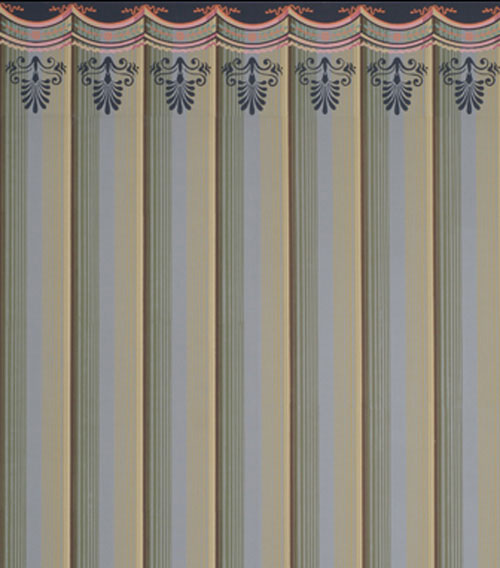
For those unable to buy tons of satin and velvet, there was always wallpaper — and very regal wallpaper, too.

L'Art de Vivre  |  The Vendome Press, 1989
Architectural Digest, October, 1995
L'Art de Vivre  |  The Vendome Press, 1989
The three previous images are the designs of Xavier Mader, who worked in France for the Dufour company, from 1808 to 1823. These wallpapers are an interesting social statement; while the nobility lost political relevance in France, and as the middle class grew, the preferred aesthetics remained that of the nobility.

L'Art de Vivre  |  The Vendome Press, 1989
This anonymous, delicate French wallpaper design includes the framed prints below the fabric and the surface behind them — wallpaper of fabric upon fabric.

Photo, Robert Lautman | Greek Revival America  | Kennedy | Stewart Tabori & Chang, 1989
The Neoclassic fashion of curtained wallpaper extended to the United States. This is the dining room of the Campbell-Whittlesey House, in Rochester, New York. It dates to 1836.

Photo by Mick Hales  |  In the Neoclassic Style  |  Fleischmann  |  Thames and Hudson, 1988
Because it's so classic, wallpaper of draped fabric has a very stylish, contemporary look.


Adelphi Paper Hangings is a company that hand blocks historic wallpapers, including colonial and Empire designs. The story of their custom designs is most interesting, and you can access them here.
.......................................................

You'll notice a new feature on my sidebar — "Antique Button of the Month." Every month I'll be sharing a new button from my own collection. I hope you enjoy them — I think you'll find that Victorian buttons were amazingly detailed and jewel-like.

Tuesday, January 4, 2011

Lunch With Rosie the Riveter's Father


You probably don't know the name J. Howard Miller, but you've seen his work. During World War II, Miller created a poster that captured the nation's imagination, and after that, helped to inspire women's movements. The woman in the poster came to be called "Rosie the Riveter."


In Pittsburgh, back in the 1970s, I belonged to a weekly lunch group of advertising artists. We'd meet at our own table every Wednesday at Stouffer's. At 20+, I was the youngest, and Howard, at 80, was the dean of the group. Our circle included Frank Webb, Paul Rendel and Norton Peterson, all great artists. The five of us were regulars, and other advertisers would occasionally drop in, so our lunches had the feel of the Algonquin Round Table.

Conversation would cover politics, history and art, and when talk turned to advertising, Howard, who was a supreme raconteur, always had interesting stories to tell. He had started as an advertising illustrator in the 1920s, and his career grew with the industry. One evening he showed me his portfolio pieces from the 1920s and 1930s and they were staggering in their detail and technique. I remember in particular one ink drawing of a stadium completely filled with spectators, and every single little body had a well-delineated posture and expression, its own personality. Interestingly, Howard's war posters were a footnote in his life, and I never even heard him talk about them. What he really enjoyed recalling were his days as a creator of car ads, in Detroit.


This is not an illustration by Miller, but it is in the genre of his work — it's something he might have done. Howard explained that in the days when ads like this were created, such a painting would be the group effort of a staff of specialized illustrators. One artist would draw the car, one would specialize in painting metallic reflections, one would paint the background, and one would paint human figures. An ad like this might have been the work of four or five people, and when you know that, you can easily see it. There were even artists in Detroit whose forte was to realistically expand car interior perspectives so that they looked more roomy. Howard said that such collaborative work was the norm in the early days of advertising. There were art studios, for example, that specialized in painting shoe ads, and within that studio one person might have had sole responsibility for painting shoe laces! Howard was very proud of his auto ads, and he must have been very good, because for many years, an auto company would gift him with a new car on Christmas Day.


By the time I knew J. Howard Miller, he had developed a tremor in his hands. Another artist would have put away his pens and brushes, but Howard continued to draw every day into his 80s. And then an interesting thing happened. Clients looked at his shaky lines and saw character and style. To Howard's delight, a second career was born.


 Iron City Beer even commissioned a series of Pittsburgh landmark cans.

Howard hand-made his Christmas cards,
and I count his work amongst my treasures. 

At the time that I first posted this (January 4, 2011), I gave credit to Geraldine Hoff Doyle for being the model for "Rosie the Riveter," as shown below. I have since heard from John Fraley, my ninth commentor, who has graciously corrected me, and encouraged me to further research the subject. All evidence in fact points to Naomi Parker Fraley as Miller's model. To read more about Naomi Parker Fraley, click here.


Naomi Parker Fraley, credited with being the true "Rosie the Riviter." 
Naomi Parker Fraley died January 20, 2018, at the age of 96.

Note: One can find a short biography of J. Howard Miller on Wikipedia, but his birth and death years are off by about twenty years. J. Howard Miller was a working professional by the 1920s, and we celebrated his 80th birthday well before 1979.


Saturday, January 1, 2011

Happy New Year!

For a number of years, I've been collecting daguerreotypes, ambrotypes and tintypes. Along the way, I've also become infatuated with their gutta percha cases, also known as union cases. I'm starting the new year by bringing you the collection on three separate pages. You'll find them in the right-hand column under the camera header.

I hope you can set some time aside to visit the collection, and that viewing it brings you as much pleasure as collecting it has brought me. Happy New Year!