Sunday, December 5, 2010

The Original Shabby Chic


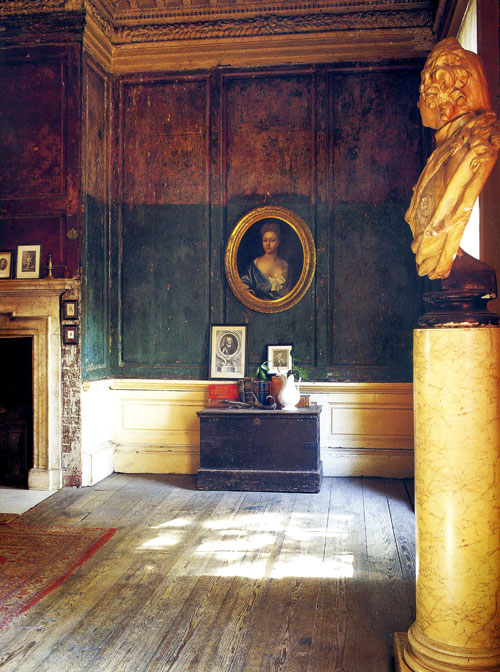
"I would have finished painting around the mantle,
but I just didn't feel like moving that vase."

"We knew Jerry didn't like the mezzotints,
but we didn't expect the target practice!"

The first photograph is by Derry Moore,
from The Englishman's Room, Alvilde Lees-Milne, 1986.
All other are by Barbara and René Stoeltie,
from Irish Georgian, Herbert Ypma, 1998.

Thursday, December 2, 2010

Guy Billout, the Ironic Illustrator


Guy Billout (b. 1941) is a French illustrator whose work has been featured regularly for years in The Atlantic Monthly. His style is characterized by delicate and economical line work, heavy shadows, beautiful gradients and almost always, irony. The following examples of his work have all appeared in The Atlantic Monthly. More great illustrations can be seen at Guy Billout's Web gallery, here.

"Edge," 1984
"Phobia," 1984
"Rescue," February, 1985
"Excavation," 1985
"The Childhood of Hercules," May, 2002
"Meeting," March, 2005
"Boat Ride," May, 2005
"Step," October, 2005
"American Sunrise," November, 2007
"Lights," November, 2008

Monday, November 29, 2010

The Reward of the Great Eastern

I collect 19th century school rewards, which were known as Rewards of Merit. In the second half of the century, they were usually lithographed and looked like little trade cards, but in the early 1800s, they were engraved and looked like bank notes. In fact, sometimes these bond-like rewards could be saved up by students and redeemed for a larger prize, like a book or watercolor set.

One of my rewards is this engraving of a metal-hulled ship with paddles, masts and a funnel. Though the masts are too few, I wonder if the artist intended the engraving to represent the Great Eastern.

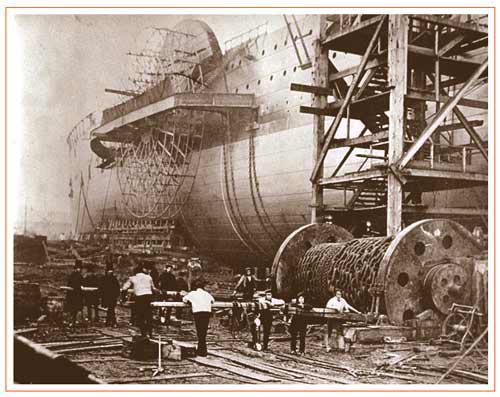
In 1852, Isambard Kingdom Brunel designed a ship to transport emigrants to the United States. It was 692 feet long, which was six times larger than any ship of the time. It could hold 4,000 passengers, and was named the Great Eastern.

 The Great Eastern was launched January 31, 1858, after several false attempts.

The Great Eastern had six masts, two paddle wheels, one propeller and five engines. It was the first ship to use a double-skinned hull, and its launch was the source of much excitement. It had a long career, was used to lay a good portion of the transatlantic telegraph cable, and was finally broken apart in 1889.

What I enjoy about this reward — whether or not it represents the Great Eastern — is knowing that the child who received it was probably as excited as if it had been of a photograph of a rocket blasting off into space! And isn't it so much classier than this?


Friday, November 26, 2010

Contemporary Brick Art


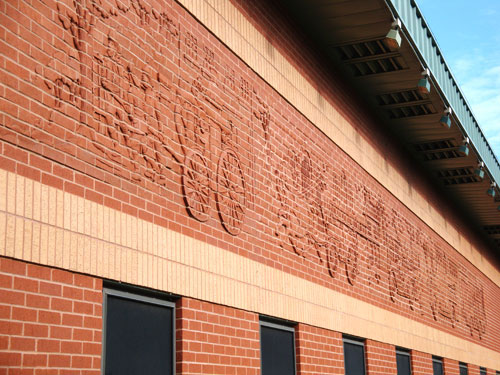
Fire Station No. 3 in St. Petersburg, Florida, features a long wall of brick art
that depicts the history and evolution of St. Petersburg's fire engines. The art
is situated high on the building and can't be easily photographed, so I'll share some details that were photographed from ground level, looking up.


I don't know who the artist is, but I will research the name and add it
to this page. I think he or she did a superb job!

Wednesday, November 24, 2010

More Than Enough

French wallpaper, 1825 | Hirschl & Adler Galleries, Inc. | Architectural Digest, October 1995

I grew up in a house that had an ottoman that was covered with a needlepoint of a cornucopia. As a child, I found the concept and the image a little strange. Now, immersed as I am in things Neoclassic, I'm rather fond of cornucopia, and I take notice when I see them. And what I've been noticing is that cornucopia often come in pairs, which makes a lot of sense from a design perspective (we can't resist the symmetrical flourishes), but of course if one cornucopia represents plenty, two must be more than enough.

On your Thanksgiving, I hope that you are able to celebrate the plenty in your life, and just to remind you, I offer this posting of double cornucopia.


Russian Imperial Style, by Laira Cerwinske. Photograph by Anthony Johnson, 1990


Ivan Bilibin, Abrams Aurora, 1981


The doorway to Peter Paul Rubens' home and studio. Photography by Marianne Haas, 1982.


Sunday, November 21, 2010

Chihuly Collection, St. Petersburg, Florida

Mille Fiori. Photography by Al Hurley, 2010
    
It's actually quite rare for a museum to be dedicated solely to one artist, and now St. Petersburg, Florida has two – the Salvador Dali Museum and the Chihuly Collection, presented by the Morean Arts Center.

Six years ago, the Museum of Fine Arts, St. Petersburg, hosted a very popular exhibition of Dale Chihuly's work. Chihuly fell in love with the city, and largely through the efforts of architect Albert Alfonso, committed to the museum, which opened in July of 2010. It's the first installation of Dale Chihuly's glass in a site designed specifically for that purpose.

Below is the floor plan of the 10,000 square-foot museum, which also contains a gift shop and a small theater.


Outside the Chihuly Collection at night

Morean Sea Forms. Photography by Al Hurley, 2010
The Morean Arts Center says this about Dale Chihuly: "A pioneer of the studio glass movement, Chihuly is credited with transforming the methods of creating glass art and thereby leading the development of complex, multi-part glass sculptures and environmental art."

Mille Fioro. Photography by Al Hurley, 2010
Float Boat, bottom image. Photography by Scott M. Leen, 2010
Some of the popular installations from the 2004 exhibit have been recreated in the permanent exhibition. The party boat, top, was from the 2004 installation; the boat below is one of the favorite pieces of the Chihuly Collection. The yellow-orange ball to the right is approximately the size of a beach ball. The installation rests upon reflective black Plexiglas and is absolutely dazzling!


I thought this might be an appropriate spot to share my own collection of glass marbles, arranged Chihuly-like in a shell.

The Chihuly Collection
400 Beach Drive, St. Petersburg, Florida 33701
Open seven day a week